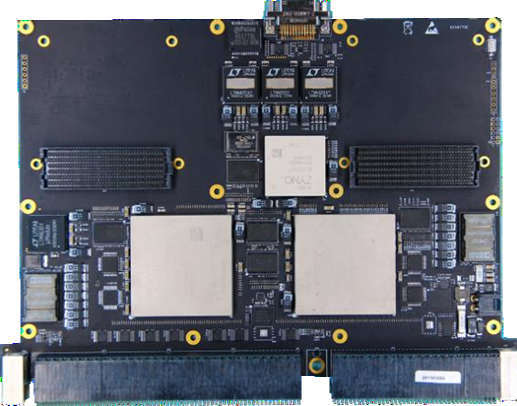
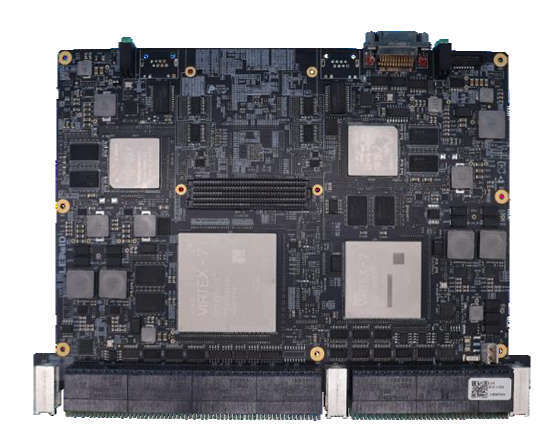
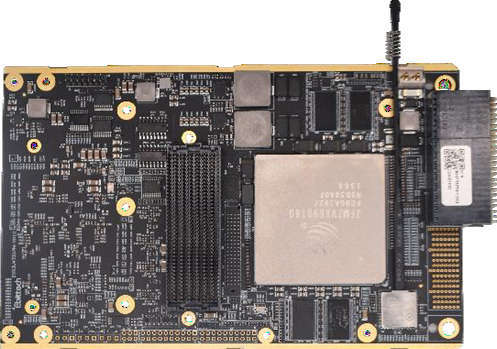
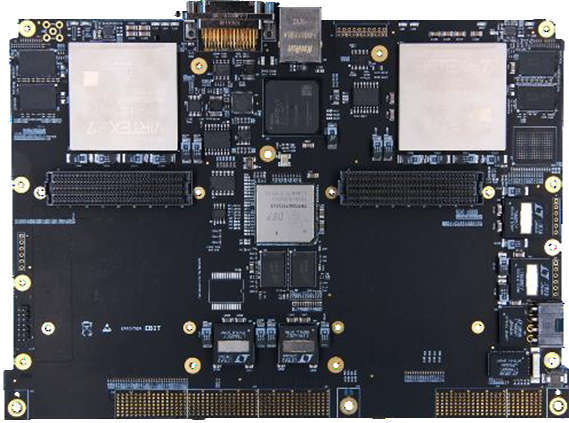
Form factors
OpenVPX, assembled
Most engineers meet high-speed capture on a PCIe card in a workstation. VPX is what you move to when one host can no longer be the centre of the system — and it is easier to see than to read about.
Press Play assembly to populate the chassis, or step through the slots. Proportions follow the standard — 233.35 × 160 mm cards on a 25.4 mm pitch — but component detail is representative.
If you are coming from PCIe
Four things that work differently
The backplane is the system
In a PCIe box the motherboard is the system and cards hang off it. In VPX the backplane is a passive fabric and every card is a peer. Which card talks to which is a property of the backplane you choose, not of the cards.
Cards are peers, not peripherals
A processing card can stream straight to a recorder card without going through a host. That is the whole reason to use the form factor: the data never has to detour through somebody’s CPU.
Slot pitch and card size are fixed
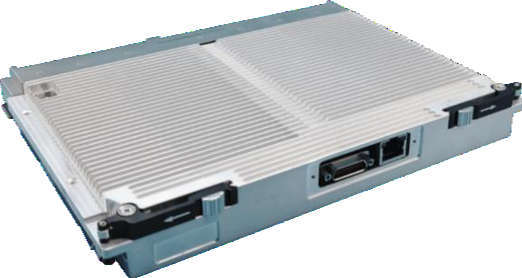
6U cards are 233.35 mm tall and 160 mm deep, at a 25.4 mm slot pitch. 3U cards are half the height. Mechanically everything is decided before you start.
Ejector handles, not screws
Cards seat against the backplane connectors under the force of the injector handles, and come out the same way. Servicing a slot is a ten-second job.
Do you actually need it?
Often not, and we would rather say so early. A single PCIe carrier in a workstation sustains about 3.6 GB/s to host memory and costs a fraction of a chassis. If one carrier and one host cover your bandwidth, channel count and run length, that is the right answer.
VPX earns its cost when one of these is true: you need several processing cards cooperating over a fabric rather than through a host; you need to record faster than a host can absorb; the system has to survive shock, vibration or a temperature range a workstation will not; or the system has to drop into a rack that is already specified as VPX.
Our cards
What goes in the slots